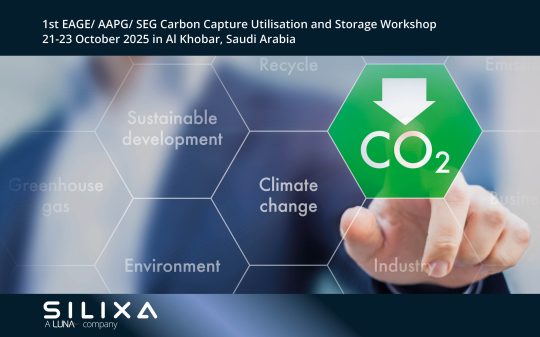

Interest in Carbon Capture and Storage has been growing at an unprecedented rate in recent years as it is a tool that can limit climate change impact. However, to meet the demand for improved CO2 capture systems, it is inevitable to invest in cutting-edge technologies that make CCS and CCUS economically viable and safe.
The CCS4G and Gephysics Seminar, a one-day symposium on the geoscience aspects of geological CO2 storage, will offer deep technical insights into topics pertinent to CCS.
Glynn Williams, Silixa’s CEO, will be presenting on the use of Fibre Optic Distributed Sensing Systems for the monitoring of geological storage of Co2.
Operators of geological storage of CO2 are required to meet annual monitoring, measuring and verification (MMV) reporting requirements to ensure the safe storage of CO2. Fibre optic distributed sensing techniques have been employed for over a decade to assure containment within the storage area and will assist in determining conformance as injection volumes are now rising in the present and near future periods. Use of a high signal to noise ratio (SNR) distributed acoustic sensor has been proven to greatly reduce active source requirements and has led to the development of a remotely operated terrestrial solution of which components can be adapted for offshore use.
Glynn’s presentation will provide an overview of the technology together with a series of short case studies featuring use of the technologies. They will illustrate how the technology has been evolved and adopted in several different regions.
The presentation will conclude with a short discussion on the challenges that have to be addressed when moving to an offshore environment.
For more information, please Contact Us.
Related links: